
Reviews for “Ode to the Unknown Factory Worker”
(2011)
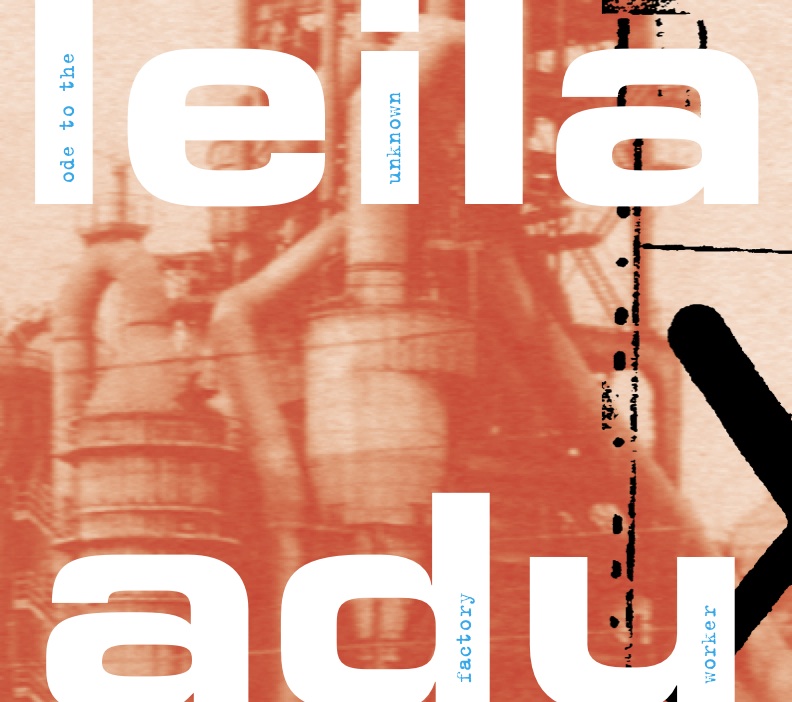
MTV Iggy
Bands We Like: New Zealander Leila Adu’s Mercurial Keys
Leila Adu is an artist with the ability to strike endlessly fascinating balances. She is a classically trained pianist, with a graduate degree in composition, who plays a lot of rock clubs and festivals. Her music combines the dissonance of avant garde composers and free jazz artists like Sonny Sharrock with the playful experimentation and fierce social commentary of punk provocateurs like Nina Hagen and Eve Libertine.
No doubt, it’s because of these complexities that her music appeals to such a wide range of people and allows her to cross musical boundaries with unusual ease. She has composed for both symphony orchestra and gamelan, and Nirvana producer Steve Albini recorded her album Dark Joan. He calls her “Spooky Adu.”
As a performer, this New Zealander of Ghanaian descent has the glowing magnetism of a vocal jazz diva from another era. Her smoky and resonant voice can captivate ears unaccustomed to the kind of music she makes — which is most everyone.
It’s genuinely difficult to categorize her. “Alt-pop artist” doesn’t quite fit, but “experimental composer” is even worse. She is a singer-songwriter, but more than that, she is part of a generation of highly accomplished young musicians such as Micachu, Joanna Newsom, and Esperanza Spalding who are eroding the distinctions between popular music and the increasingly academic worlds of jazz and instrumental music.
Her recently released fourth album “Ode to the Unknown Factory Worker” is as slippery and mesmerizing as anything she’s ever done. Watch the video for “Fortuna,” the second single off Ode, and enter Adu’s borderless world
– by Beverly
Art Nouveau Mag
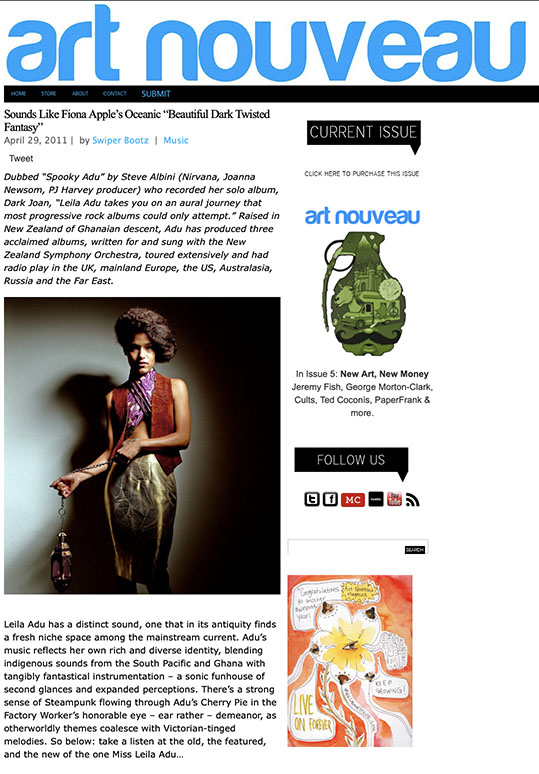
Dubbed “Spooky Adu” by Steve Albini (Nirvana, Joanna Newsom, PJ Harvey producer) who recorded her solo album, Dark Joan, “Leila Adu takes you on an aural journey that most progressive rock albums could only attempt.” Raised in New Zealand of Ghanaian descent, Adu has produced three acclaimed albums, written for and sung with the New Zealand Symphony Orchestra, toured extensively and had radio play in the UK, mainland Europe, the US, Australasia, Russia and the Far East.
Leila Adu has a distinct sound, one that in its antiquity finds a fresh niche space among the mainstream current. Adu’s music reflects her own rich and diverse identity, blending indigenous sounds from the South Pacific and Ghana with tangibly fantastical instrumentation – a sonic funhouse of second glances and expanded perceptions. There’s a strong sense of Steampunk flowing through Adu’s Cherry Pie in the Factory Worker’s honorable eye – ear rather – demeanor, as otherworldly themes coalesce with Victorian-tinged melodies. So below: take a listen at the old, the featured, and the new of the one Miss Leila Adu…
“Walk My Road”
BlinkkIt: Funeral organs herald in the the ambiance of a funhouse carnival, as Adu croons over off-kilter piano scaled staccato… rhythmically detached percussion sets a subtle manic procession… “You make me feel like a spinster in a tower,” lyrically navigates the listener through amber waves of antiquated instrumentation… Rapunzel weaves through the song, from the tangibly tangled melody, and the timbre of amber tresses effortlessly flowing along to the familiar sounds of fairy taled timeless era, and renaissance perceived past…
Sounds Like: Fiona Apple’s “Oceanic Beautiful Dark Twisted Fantasy.
“Martian Raft”
BlinkkIt: “Martian Raft” sails along like an intergalactic acoustic lullaby. There’s an undeniable extraterrestrial feel as Adu makes the most of the ever-elusive, yet ever-enveloping negative sonic space. The lone keyboard emphasizes Adu’s vocals, echoing the expansive sense of minimalism beneath the deft-yet-dainty keystrokes. Even though the track holds only a keyboard in its instrumental arsenal, the notes play along as if from the indexes of a prodigy – effortlessly masterful, with a unknowingly humble sense of whimsy. Adu’s voice navigates the listener through the narrative, guiding but not imposing direction… still, there remains the innate intangible connection to the song’s simplistically hypnotic human chord progression… childlike in an awestruck way… wonderful.
Sounds Like: Spoken word starry socio-scaped lullaby.
– by Swiper Bootz
Original Article
Stone Free
“Leila Adu is too good and musically uncategorizable to be ignored.”
Ghetto Punkrocker:
Review of “Fortuna” Video Single
Hey folks, yeah… I’m not going to the usual “psychological analysis” regarding Leila Adu’s song “Fortuna.” Breaking this down would tarnish the beauty of the song. Leila Adu is that rare kind of artist who can render me speechless with her music. Knowing that I talk a lot and analyze music very seriously, hearing a song that rends me speechless is a feat in itself. With “Fortuna” from the images she paints lyrically to the haunting organ sound with drums that compliment her playing is hypnotic.
This is something you have to listen to for yourself and let resonate and you don’t need me to kibitz on in this instance. Enjoy!
All About Jazz Italia
Difficile catalogare l’ultima, bellissima, uscita discografica di Leila Adu, prodotta da Rai Trade per la collana Tracce. Già lei stessa un mosaico di etnie e nazionalità diverse (neozelandese di origini ghanesi, Londra e Roma principali centri di attività), Leila Adu ha studiato ed è impegnata su fronti molto diversi, dalla musica contemporanea al blues e alla musica etnica (ascoltare lo stupendo Truth in the Abstract Blues con Mike Cooper e Fabrizio Spera, sempre per Rai Trade), da alcuni dischi pop dall’orchestrazione atipica alle esperienze di improvvisazione radicale sulla scena romana e londinese. Strano a dirsi, molto di questo background è presente in Ode to the Unknown Factory Worker, un’opera tanto più complessa quanto semplice, quasi disarmata, la sua formula strumentale, fatta di voce e tastiera (in alcuni pezzi accompagnate dalla batteria di Daniele De Santis).
Adu è stata infatti capace di fare di questa dimensione monologica, quasi spettrale, tenuta per così dire al di qua di qualsiasi arrangiamento, una forma autonoma, in cui le sue tante anime musicali vivono e trovano una loro naturale contiguità, ma quasi appunto come spiriti, spettri: si ha come l’impressione di trovarsi di fronte a quella situazione elementare, intima e grezza allo stesso tempo, nella quale prendono vita tutte le creazioni. Ovviamente tutto questo funziona perché Adu è un grande talento, sia come compositrice che come performer: sentire ad esempio la splendida “Trojan Cow,” in cui le linee blues della voce incrociano, come avviene spesso nel disco, qualcosa come tracce di canzoni popolari di tradizione europea – addirittura nenie, filastrocche – che sembrano recepite anche attraverso la tradizione colta del Novecento (viene in mente Charles Ives, si ascolti pure “Brazen Hussy”); o la title track, in cui l’approccio percussivo e dissonante della tastiera sostiene a tempo di uno straniante ritmo di marcia le cadenze di nuovo blues della voce, qualcosa di astratto ed esaltante insieme.
La voce è vertiginosa pur rimanendo, coerentemente, per lo più nel registro medio; le composizioni sono spesso costruite per giustapposizione di episodi diversi, con un effetto meccanico, e spesso il flusso di una melodia si blocca, come quando ci si esercita al pianoforte e si riprende da un punto appena precedente: il tutto col risultato di accrescere in modo inatteso la tensione emotiva.
A volte arrivano suggerimenti in direzioni ancora diverse: gli effetti impiegati all’attacco di “Slick Department Store” fanno pensare al filone post-punk/new wave, così come il suono oscuro dell’organo elettrico impiegato in alcuni pezzi, se non la stessa ruvida essenzialità delle composizioni.
Certo, molti potranno leggere questo disco piuttosto come una esperienza di songwriting indie-rock, ma lo spirito della musica di Leila Adu pare in realtà diverso, e più ricco. Del pop – quello vero – ha però senz’altro una cosa: il carattere inesplicabilmente ipnotico, la capacità di guadagnarsi sotto traccia uno spazio emotivo sempre più ampio ad ogni ascolto.
URB ALT: Album in the Crosshairs
I don’t see Leila Adu around town every day, but I’ve met her enough times where it would be downright rude of me to see her in a tea shop and not discuss the weather or each other’s lives. Minor disclosure aside, my rule still stands – anyone who gives me access to their music to review should expect me to offer a straightforward assessment, irrespective of what the artist thinks about that perspective. My summary impressions of Leila Adu’s new Ode to the Unknown Factory Worker album – a minimally arranged set that features Adu on keys and the occasional drumming of Daniele De Santis (from MDF) – is that she and I will not likely share weird moments in a public setting because of what I have to say about it. Ode is a collection of songs that reflect the personal challenges of someone who has traveled world alone as Adu has done, and is a compelling set that offers a sharp differentiator from the growing army of self-labeled “singer/songwriter” trendies who feel their titles alone should command instant love at the record stores. Adu’s music acknowledges the same emotions most of us humans experience but she takes us on a low-key and highly illustrative path to arrive at similar places. Alternative music palates will be attracted to the naked delivery of these songs, but Adu goes further by deceptively dressing her compositions in layers of Pop hooks, literary devices, and classical or chamber music sensibilities. The Blues patterns practically jump into your ears. Adu’s new album will earn your affection.
– by Kambui
Rockerilla
Leila Adu’s fourth album confirms the radical nature of the New Zealander with Ghanaian origins. Ode to the Unknown Factory Worker is a nude and crude album (voice and piano with inserts of organ and drums.) It is edgy and sparse in places yet deep and rich at the same time with a strong lyrical tension that embraces classical music and blues roots, research and experimentation, fractured harmony and vertical improvisation, introspection and social unease, in a continuous game between notions of “inside” and outside.” The voice is intense and magnetic, ancestral and contemporary; it travels across paths that are slanted, unforeseen, built on contrast and dissonance and which guide us through unexplored territories.
(Translated from Italian)
Blow Up Magazine
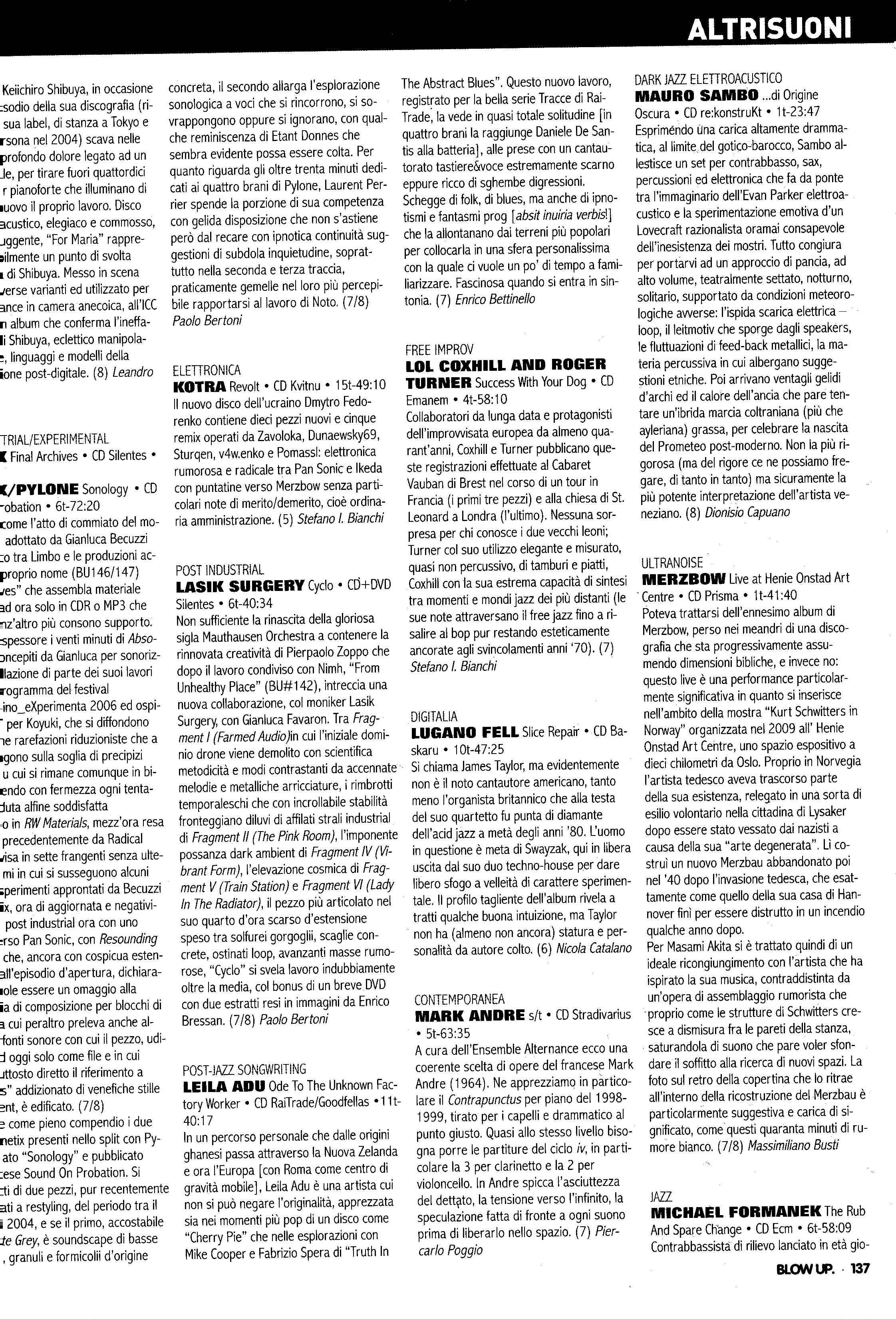
On a personal journey with Ghanaian roots which pass through New Zealand and now Europe (with Rome as a base of movement), Leila Adu is an artist whose originality one cannot deny with more pop moments treasured in an album like “Cherry Pie” than in explorations with Mike Cooper and Fabrizio Spera in “Truth in the Abstract Blues.” This new CD, “Ode to the Unknown Factory Worker,” recorded for Rai Trade’s beautiful Tracce series, sees her working in almost total solitude (in four songs she is joined by Daniele de Santis on drums) as a singer-songwriter with extremely sparse piano and vocals. The rich off-kilter digressions display splinters of folk and blues but also hypnotic and ghostly prog [absit inuria verbis!] that move away from more popular terrains and put her in a personal sphere with which you want a little time to familiarize yourself. The music is fascinating when you become attuned to it.
– by Enrico Bettinello
(Translated from Italian)
Original Article
Sentire Ascoltare
Leila Adu is a living melting pot with Ghanaian origins and a New Zealand passport. She accommodated academic musical studies in modern electroacoustics, ethnomusicology and orchestration with a passion for improvisation and electronica. Since 2003 she has delivered three albums of “crossover” songs. These recordings of transcendent piano and a voice of peculiar expressiveness search and often solve an impossible riddle. Leila’s music has benefited from the presence of Steve Beresford, Lol Coxhill, Steve Albini and ex members of Rip Rig & Panic. As if that was not enough she has made the time to compose music for dance, theatre and film as well as held singing courses of semi-improvisation for children. In your face!
After arriving at Rai Trade/Tracce with Truth in the Abstract Blues — a trio also including guitarist Mike Cooper and drummer Fabrizio Spera — Leila has redoubled her efforts in the spartan and intense album “Ode to the Unknown Factory Worker” with a palette of black and white keys including four songs with of drums from the skillful and measured Daniele de Santis. The minimalist use of intimate watercolours make one think of Joni Mitchell brimming with melanin, White Magic (Cigarettes & Circus Puffs) or a modernist Nico who has Freudianly washed away the gothic (the splendid ‘Fortuna.’). Leila is a spirit willing to let go to angular emotionality (the title track, Brazen Hussy) as much as applying self-control and romanticism that is never banal. Referencing Bill Evans, these are conversations with herself that — after surpassing the initial difficulty — you discover that you have become accustomed to. “Ode to the Unknown Factory Workers” discourse cancels out the excessive vacuity and feedback that at times infests our daily lives.
(Translated from Italian)